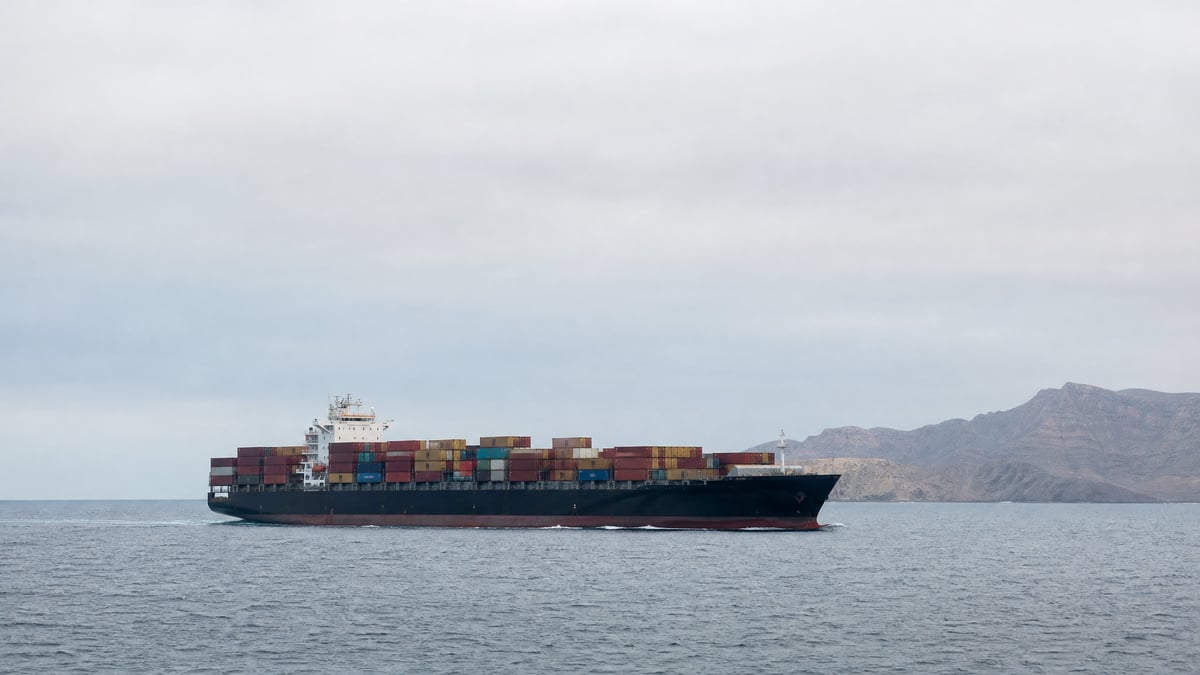
A container ship carrying more than 2,500 containers sank in the Strait of Hormuz after striking a naval mine, Iran's Revolutionary Guards Navy said Wednesday -- the latest flashpoint in Tehran's campaign to drive up oil prices ahead of the U.S. midterms.

The Strait of Hormuz, the narrow chokepoint that carries roughly one-fifth of the world's oil, became a fresh flashpoint on Wednesday after a container ship carrying more than 2,500 containers struck a naval mine and sank in waters south of the passage. Iran's Revolutionary Guards Navy confirmed the sinking, claiming the vessel had tried to transit an "unauthorized and dangerous" route before it caught fire and went under.
The Guards warned local vessels and fishermen to steer clear, deepening the uncertainty around a waterway where commercial traffic had only recently begun to recover. Britain's maritime monitoring office, UK Maritime Trade Operations, separately reported that a container ship had been struck by an unknown projectile, though it was not immediately clear whether the two reports described the same vessel.
Iranian officials have not hidden the strategy behind the disruption. Two senior officials said Tehran is deploying new tactics against ships in the strait as it seeks to keep oil prices elevated and influence the U.S. midterm elections.
"The aim is to frustrate efforts by the United States and its allies to bring down global oil prices," one of the officials said. A second official put the campaign in blunter terms: "Just when they think they are getting close to the point where prices will fall, we will push them away from it. This is a game of chess."
The officials said Tehran would extend the scope of its operations beyond the strait into the Gulf of Oman and waters farther away. Maritime security reporting over recent days appears to bear that out, with incidents recorded off the coasts of Qatar and the United Arab Emirates, outside the traditional boundaries of the chokepoint.
It is a pattern the regime has leaned on before. Iran has repeatedly struck commercial vessels in the Strait of Hormuz, using drones, mines and small craft to choke a route the global economy cannot easily replace.
Separately, Iranian state-linked media reported that three fishermen were injured when a fishing boat was struck by an unidentified drone near Sirik in southern Iran's Hormozgan province. Tasnim described it as an attack by a U.S. drone, though Iranian authorities did not officially confirm who was responsible.
U.S. Central Command flatly rejected the idea that Iran controls the passage. In a post Tuesday, the command noted that its top naval officer "has no navy" and that American forces and regional partners had helped move more than 19 million barrels of crude oil through the strait "just yesterday."
President Trump has kept maximum pressure on Tehran as the confrontation grinds on. Speaking outside the White House on Tuesday, he called Iran a "failed country" and said Washington would decide its next move "very soon."
"They have no economy... they have no money," Trump said. "We'll make a decision on Iran very soon."
He sharpened the threat again at a campaign rally, warning that Iran "will not have a nuclear weapon" and taunting Tehran over its shrinking leverage: "Wait till you see what we do to Iran."
Before the war, between 125 and 140 large commercial vessels, including oil tankers, gas carriers and container ships, moved through the strait every day. That traffic came to an effective standstill on Feb. 28, when the United States and Israel launched coordinated strikes across Iran.
Recovery has been fitful. Each new attack on shipping pushes insurance premiums higher, gives shipowners another reason to reroute, and hands Tehran exactly what it says it wants: a firmer floor under crude prices heading into November. That pressure has already worked its way into the wider economy, where mortgage rates have pushed past 7 percent for the first time since 2024.
Western governments have tried to answer in kind. The G7 has coordinated releases from strategic reserves, and the Trump administration has paired sanctions pressure and new energy deals with its military posture to keep fuel costs from spiking further at the pump.
Three things will shape what happens from here. First, whether maritime authorities and insurers escalate their warnings, which would slow traffic through the strait and add to price pressure. Second, whether Iran widens its attacks beyond the chokepoint into the Gulf of Oman and beyond, testing the U.S. Navy's ability to escort shipping. And third, whether Trump orders a direct response before the midterms, weighing the cost of restraint against the political price of rising gas prices.
For now, the sinking stands as the latest reminder that the world's most important oil artery is also one of its most exposed -- and that Tehran is willing to keep squeezing it while Washington decides how hard to squeeze back.


A container ship carrying more than 2,500 containers sank in the Strait of Hormuz after striking a naval mine, Iran's Revolutionary Guards Navy said Wednesday -- the latest flashpoint in Tehran's campaign to drive up oil prices ahead of the U.S. midterms.
freedomlinedispatch.com