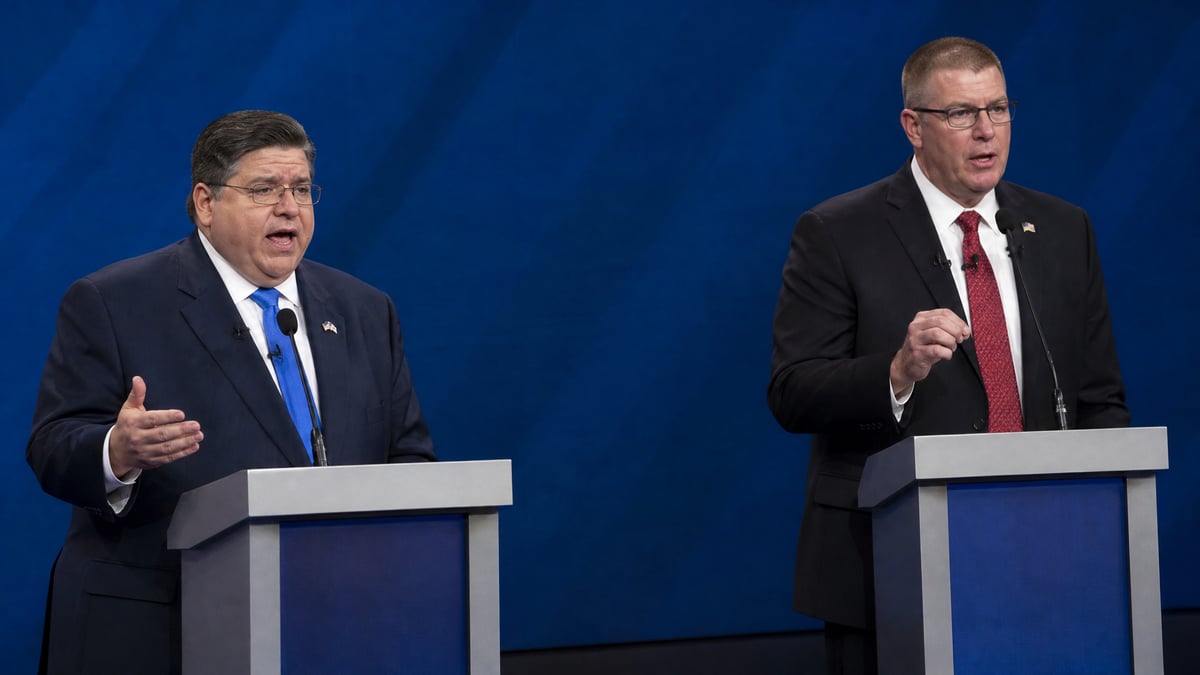
Republican Darren Bailey pressed Gov. JB Pritzker on Illinois' $85.6 billion tax burden, energy costs and public safety in the only debate of the governor's race, as the Democrat leaned on President Trump.

Illinois Republican Darren Bailey took Gov. JB Pritzker's tax-and-spend record straight to the incumbent Tuesday night, using the only televised debate of the governor's race to press the Democrat on taxes, energy costs and public safety while Pritzker worked to turn the contest into a referendum on President Donald Trump. The hourlong WTTW News forum on Chicago's North Side was the first and last time the two candidates will share a stage before the midterm election on Nov. 3. It was a rematch of 2022, when Pritzker, the billionaire heir to the Hyatt hotel fortune, beat Bailey by roughly 12 points -- a margin Republicans insist has narrowed as Illinois households absorb years of rising state spending and utility bills.
Bailey came ready for Pritzker's preferred line of attack. Before the forum began, the downstate farmer and former state lawmaker told viewers to "fill up your glass of water, your iced tea, your lemonade, and every time that he mentions Trump, let's take a drink." He repeated the routine throughout the hour as Pritzker linked him to the president and to federal cuts. "It's time for Gov. Pritzker to own the failures and the problems of Illinois, because theoretically, with eight years in the supermajority, we shouldn't be dealing with these issues," Bailey said.
Pritzker leaned hard on Trump, blaming him for affordability problems and for reductions in Medicaid and food assistance that the governor said are squeezing families across the state. Bailey pushed back that federal questions were not his to answer. "I think we're all ready for the tariffs to end. I think we're ready for the war in Iran to end," Bailey said. "This sounds like this is a debate about the presidency of the United States with President Trump."
The exchange produced one of the night's sharper moments. When Bailey said he was not "running for president like JB Pritzker is," the governor shot back, "I'm flattered that you think I could get elected president of the United States." Bailey, who won the 2022 Republican primary on his way to the general-election loss, has spent the fall campaign trying to court Chicago-area voters who rejected him four years ago.
The single-debate schedule has become a fixture of this cycle's governor races, a format that put the Illinois matchup alongside Pennsylvania's only governor debate between Josh Shapiro and Stacy Garrity.
Bailey's central case was cost. By the Illinois Policy Institute's accounting, the state has imposed 63 tax and fee increases since Pritzker took office in 2019, lifting the state tax burden by $85.6 billion through fiscal 2026. Last fiscal year alone, Illinoisans and businesses paid about $15.2 billion more in state taxes than they would have at pre-Pritzker levels.
The same ledger shows the gas tax doubling from 19 cents to 38 cents a gallon in 2019 and reaching 48.3 cents today, property taxes up 27% under Pritzker, and more than $35 billion in personal income leaving the state. Private-sector job growth over the period came in under 0.1%, and average wages were flat.
Bailey used the debate to demand a "forensic audit" of a state budget he said lawmakers barely read. "At two in the morning, you're given this budget, 5,000 pages, and you're told to pass it," he said. "Even the Democrats themselves don't know what's in there." He has pledged a Department of Government Efficiency-style review if voters send him to Springfield.
On revenue, Bailey rejected the left's favorite answer. "If we continue to tax the rich, that's a socialist mentality and we can't afford to do that," he said. Pritzker sidestepped a question about putting a millionaire's tax on the ballot and instead faulted Bailey for voting against budgets while he served in the legislature.
Energy drew some of the clearest contrasts of the night. Bailey blamed the state's two climate and energy measures, which push fossil fuels offline by 2045, for rising electric bills. "We're phasing out reliable energy far too soon," he said. "I have no problem with bringing on what we suppose is clean energy, but we all know the wind doesn't always blow, and the sun doesn't always shine."
Pritzker has paused state incentives for data center construction and wants lawmakers to pass the POWER Act in November, a measure meant to force data centers to supply their own power. Bailey said the state handed tax breaks to data centers and then watched utility prices climb anyway.
On schools, Pritzker pointed to about $3 billion in added education funding under the state's Evidence-Based Funding formula but would not commit to Chicago Public Schools' request for another $150 million during the fall veto session. Bailey said the formula had failed. "Evidence-Based Funding is not working because Evidence-Based Funding suggests that more money is the answer," he said, arguing the state should cut unfunded mandates instead. He pledged to replace the entire State Board of Education.
Public safety produced the most personal moment. Bailey invoked two Illinois cases -- Sheridan Gorman, killed in Chicago by a man from Venezuela who was in the country illegally, and Katie Abraham, killed in a hit-and-run blamed on a Guatemalan man without legal status -- and asked Pritzker whether he had said their names. Pritzker accused Bailey of exploiting grief, saying he "likes to exploit people's pain for political gain."
The two also fought over the SAFE-T Act, the 2021 law that ended cash bail in Illinois. Bailey wants it repealed and pointed to recent offenses by people on electronic monitoring. Pritzker said he is open to changes but defended the law, arguing that returning to cash bail would let "the most violent criminals buy their way out of jail."
Bailey also faulted Pritzker for scaling back services at the Choate Mental Health and Developmental Center in Anna, warning the move would strain southern Illinois. Pritzker said he had promised to close the abuse-plagued facility if it could not be fixed, and that he followed through.
A stadium fight hangs over the race's final weeks. Pritzker said a "billionaire family owning a $9 billion valued team does not need us to buy them or build them a stadium," while leaving the door open to state help with infrastructure to keep the Chicago Bears in Illinois. Bailey said the team is headed for Indiana and that Pritzker would be remembered as the governor who let it leave.
Independent candidate Collin Corbett was left off the stage and criticized the exclusion in a statement, arguing the two-party matchup denied voters a full accounting of the governor's record on affordability.
With three weeks until the polls close, the Illinois race now turns on whether Pritzker's appeals to Trump-era grievances can outweigh a tax and cost-of-living record that Bailey and his allies intend to keep at the center of the campaign. Lawmakers return in November for a veto session, where the governor wants action on the POWER Act and a Bears package -- two more chances for voters to weigh which candidate they believe.


Republican Darren Bailey pressed Gov. JB Pritzker on Illinois' $85.6 billion tax burden, energy costs and public safety in the only debate of the governor's race, as the Democrat leaned on President Trump.
freedomlinedispatch.com