Rep. Andy Harris clashed with a Cambridge audience and then with reporters Tuesday night, as surging diesel prices and the administration's Russia fuel deal dominated his debate with Democrat Dan Schwartz.

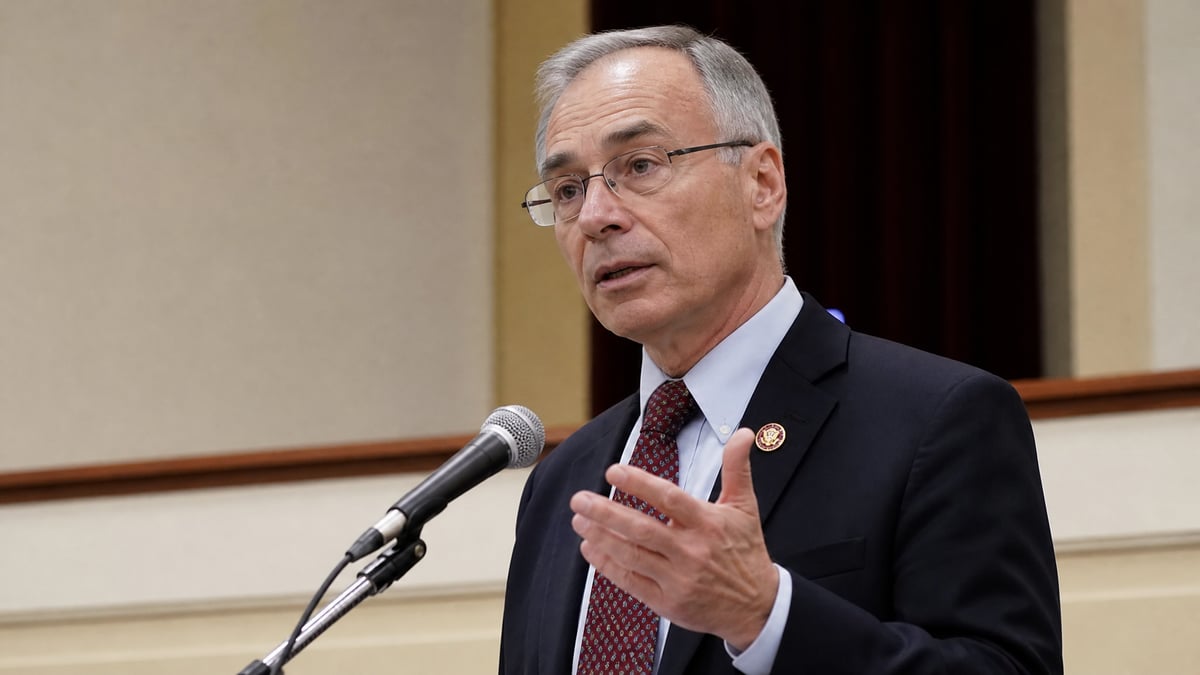
Rep. Andy Harris took the stage in Cambridge, Maryland, on Tuesday night to make his case for a ninth term. He left it after a forum that turned on the price of diesel, a run-in with his own constituents, and a post-debate confrontation with reporters over a state recording law he said they had violated.
The debate, hosted by the League of Women Voters of the Mid-Shore, was meant to give voters in Maryland's First Congressional District a direct look at the Republican incumbent and his Democratic challenger, Dan Schwartz. Instead it put the national fight over fuel prices on display in a single room.
Harris, who chairs the House Freedom Caucus and is the only Republican in Maryland's congressional delegation, fielded the first flashpoint when both candidates were asked about the administration's decision to buy diesel from Russia while the war with Iran continues. The temporary waiver, which eases sanctions on Russian diesel and runs into 2027, has divided Washington and pushed energy costs toward the center of the midterm fight.
Schwartz came out swinging. "Making a deal with Russia to lift sanctions on their diesel when they are actively working with Iranian forces to kill our troops is not only wrong; it's disgusting," he said, arguing the move follows a pattern he said rewards bad actors.
Harris answered by pointing at Democratic environmental policy. "The facts are that diesel prices have gone up, there's no question about it," he said. "Why has it gone up? Because the Democrats and environmental regulations have not--"
He never finished. Laughter, groans and shouts rolled across the room, and Harris turned on the crowd. "This is the problem," he said. "You all say you believe there's a First Amendment, but only if you agree with you! You should let me finish the sentence, ma'am. You are rude!"
Glenna Heckathorn, president of the League of Women Voters of the Mid-Shore and the forum's moderator, stepped in to restore order and asked both candidates to calm their supporters. Schwartz urged the crowd to let both men be heard. Harris pointed to a second audience member. "You're rude, too," he said. "You started it," the voter fired back. The two candidates did find rare common ground on one of the state's most heated issues, agreeing on the fight over congressional redistricting.
The exchange played out against a fuel market under genuine strain. The national average for a gallon of diesel stood near $6.29 this week, up from roughly $3.65 a year ago. Regular gasoline averaged about $4.33, up from $3.07. Diesel touched $6.52 last month, the highest national average on record.
Federal energy analysts trace the surge to tight global supplies of distillate fuel and elevated crude-oil prices, with reduced refining activity in Russia, China and the Middle East tightening the market. Houthi strikes on Saudi refining sites and Ukrainian drone attacks on Russian refineries have compounded the squeeze, and Iran's grip on the Strait of Hormuz, the chokepoint carrying roughly a fifth of the world's oil, has kept a persistent risk premium in prices.
The climb was not sudden. Diesel had already shattered records earlier in the conflict, a run-up that pushed the national average to a then-record $5.85 a gallon as the fighting widened.
On the ground, the numbers bite. Wendell Meekins, a Dorchester County farmer with about 30 years in the fields, told a local television station his operation was spending more than $2,000 a day on fuel during harvest, on top of losses from drought-damaged crops. "This is just a further cut into your profit, which is making it hard to come out ahead," he said.
The debate ended; the confrontation did not. In a hallway gaggle with reporters, Harris singled out Cat Murphy of Capital News Service and told her she lacked permission to record him.
"You do not have my permission to record," Harris said. "If you record, we will refer you to the prosecutor."
"Everyone in here is recording," Murphy replied. "But you are not allowed to," Harris shot back, saying Maryland is a two-party consent state. "Because I refuse to give you permission to do recording," he said when she asked why she could not.
Maryland does require all parties to agree before a private conversation is recorded. The statute turns on whether those involved have a reasonable expectation of privacy, a standard that generally does not cover a public press gathering. A 2010 case threw out charges against a motorcyclist who recorded a traffic stop that unfolded in full view of the public, according to a state legislative analysis. The Baltimore Banner reported that Harris was wrong to tell the reporter she was breaking the law.
Harris pressed the matter anyway. "Get an officer in here," he said, insisting that "audio and video have to have two-party approval in Maryland." When another reporter noted they were standing in public, Harris replied, "Makes no difference whatsoever." He walked off telling the remaining reporters to "thank her profusely" for cutting the questioning short.
Harris is seeking a ninth term in a district that spans the Eastern Shore and reaches into the Baltimore suburbs. His leadership of the Freedom Caucus and his alignment with the administration have made him a Democratic target in a cycle where energy costs are testing incumbents across the country.
Schwartz, the Democratic nominee, is running on affordability, consumer protection and opposition to tariffs, and he argues the seat can be competitive. Public polling is sparse; an internal Democratic survey in July put Harris ahead by 13 points, and prediction markets still give the incumbent the edge.
The larger question is whether the fuel-price fight that dominated Tuesday's forum follows voters to the ballot box. Gas and diesel costs have climbed in nearly every state, and they now rank near the top of voter concerns heading into November. For Harris and Republicans nationwide, the task is making the case on energy while families feel the squeeze at the pump.


Rep. Andy Harris clashed with a Cambridge audience and then with reporters Tuesday night, as surging diesel prices and the administration's Russia fuel deal dominated his debate with Democrat Dan Schwartz.
freedomlinedispatch.com